Where club value is moving
Watch the full Itensity × Technogym industry panel. Gym Company, Wits University, Technogym and Itensity on GLP-1 members, retention, pricing, equipment and longevity, plus the takeaways operators are already acting on.
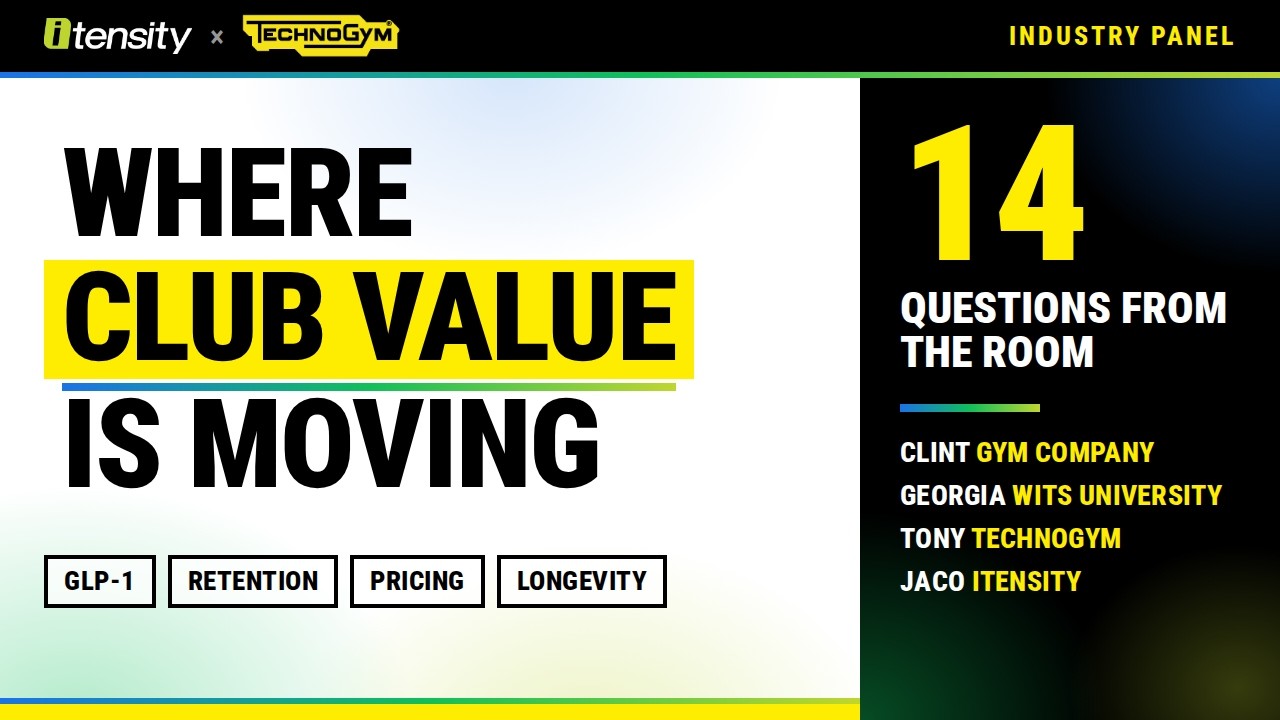
Full panel, 51 minutes. Tap any chapter below to jump straight to that question, or watch it on YouTube.
At our Itensity × Technogym meetup, Where Club Value Is Moving, we put four people on stage who see the fitness industry from very different angles, and let the operators in the room ask the questions.
Below are the moments that had people reaching for their notebooks. Every section links back to the exact point in the video, so you can hear it in their own words.
Jump to a question
Three numbers from the panel
The front door, the back door and the price ladder
Figures as quoted by Clint and Jaco on the panel. Rounded.
GLP-1 members need a pathway, not a programme
Jaco opened with a question every operator is facing. Members on GLP-1 medication are arriving in bigger numbers, often with a high BMI and little movement history. How should a gym look after them?
Georgia reframed the gym's role. With rapid weight loss, the job is to protect muscle and prevent sarcopenia, which means measuring outcomes so members know what they are losing and where.
She described three pathways every club should run: members who are healthy, members who need a little medical direction, and members who need medical supervision. GLP-1 members usually start in the third for their first 30 days to three months, then move across as their measurements improve.
Screen properly
The PAR-Q on its own is not a screening tool. Build proper pre-screening and a referral route into your gym's SOP.
Track the trend
Body impedance is good enough to alert you and follow the trend. When medical history flags a risk, refer the member for a DEXA.
Tony added that GLP-1s are forcing strength training through the industry's door, because cardio can happen outside but proper lifting happens in a gym. The opportunity is real, but only if clubs step into health safely. Programmes like Exercise is Medicine exist to train coaches to know when to refer and what to do.
The back door is as big as the front door
Asked what he would tell his 20-year-old self, Clint was honest: in the early days it was all about selling. Today Gym Company brings in between 300 and 800 new members per club every month, and the back door is just as big. Retention, built on health and wellness checkups, has become the major focus.
His point about emerging markets landed hard. Many members draw their salary in cash, debit orders bounce, and they pay whoever they choose. The ones who keep paying are the ones who keep coming in. That is why online joiners go straight into a member journey: get them into the club fast, through a checkup, and onto the floor.
How Itensity helps
Itensity ties debit orders and billing, arrears recovery and access control together, so you can see who has stopped paying, who has stopped coming, and act before they leave.
Flat fees, rising rent and the price ladder
An operator in the audience asked how Gym Company holds its prices while mall rentals keep climbing. Clint pointed to Planet Fitness in the US, which held its $10 membership for 26 years by growing its base every single year. Gym Company did the same for a decade. With industry growth now flattening, the levers are a price increase or upselling, and Gym Company is leaning on tiered memberships.
How Gym Company upsells
One entry price, two clear reasons to pay more
Tiers as Clint described them on the panel. Meter lengths are illustrative.
Close to half of Gym Company's members now pay above the entry price. Gym Company also built a R99 online membership that includes three club visits a month. It started as a tool to save members who wanted to cancel, and it now keeps them coming in for their monthly checkup. Tony compared the model to a restaurant menu: the burger gets everyone through the door, and once they are inside, most people upsell themselves. One finding surprised the room: the members on the highest fees are also the most reliable payers.
Rent or buy? Think like a coffee shop
Tony's answer was rent or finance, and match your costs to the period you earn the revenue. Equipment is only around 8% to 20% of a club's operating cost, yet it is where operators most often compromise. Rent, staff, utilities and marketing are the big lines.
The coffee shop test
A coffee shop that serves 100 cups a day would never buy five years of coffee up front. Buying all your equipment in cash does exactly that, and leaves you on the back foot, compromising on quality and product. Treat equipment as a return on investment, renew it on a logical cycle, and don't CapEx a depreciating asset.
Itensity × Technogym
Itensity is integrated with Technogym MyWellness, so member profiles sync into your connected equipment and training data stays with the member, from the front desk to the gym floor.
Longevity comes down to two metrics
Asked to cut through the longevity noise, Georgia was clear. Independent of anything else, the one parameter that most improves mortality and longevity is cardiorespiratory fitness. The second is strength. Both are trainable at any age, both can be measured in a normal training session, and both are delivered in gyms.
Tony pushed the idea further into healthy longevity: not just living longer, but living better for longer. After 50, sarcopenia accelerates, and it is the decline in strength and power that takes away quality of life.
Why strength training matters after 50
Power fades fastest, then strength, then muscle
Illustrative curves using the yearly rates Tony quoted on the panel (muscle about 1%, strength about 2%, power about 3% a year), compounded from age 50 without training. Scroll to move through the years.
Georgia then made the point that may matter most for marketing. In one study, a group told that exercise would lower blood pressure and extend life engaged less, and saw worse outcomes, than a group simply told to go walk for fun. Members don't train for longevity statistics. They train for their own story, like keeping up with their kids. And it is never too late: people in their 70s and 80s improve more, in percentage terms, than younger beginners.
The members you don't see
Jaco brought the conversation back to attendance. The picture most operators have of their gym is the member who trains five times a week. The data tells a different story.
Who is actually training
The regulars are a sliver. Most of the base is paying but not coming.
Attendance figures as quoted by Jaco on the panel, rounded. One dot is one member in 100; the twice-a-week group sits inside the 70.
100Picture 100 members on your books, all paying every month.
70About 70 of them train fewer than three times a week.
15About 15 of those make it in twice a week.
2Fewer than two train five or more times a week. That is the member most operators picture.
Tony's answer was to become part of the member's life outside the gym too: notice the parkrun, the hike, the sleep and wearable data, and use your CRM and member app to start those conversations. A good programme won't all happen inside your four walls, and the gym can still be the member's lifestyle partner.
Sell adherence, not kilos
The last question from the audience asked how clubs position themselves to get these outcomes and still grow. Jaco shared how one of the best gym salespeople in America works. He hears the member's story, then sets it aside: forget the five kilos and the wedding for now, just come twice a week this month. You can't predict weight loss. You can predict attendance.
From story to habit
Market on the story, then sell the habit
The process as Jaco described it. Funnel proportions are illustrative.
It also feeds your marketing: members who share their first milestones and tag the club become your best adverts.
Tony closed the loop: the outcomes that respond best to adherence are exactly the two Georgia named. Strength goes up when people train, and cardiovascular fitness follows.
The bottom line
Value is moving away from selling access and towards keeping members engaged, measured and progressing. That means pathways for higher-risk members, a member journey that starts the day someone joins, price tiers that give people a reason to pay more, and a focus on attendance before outcomes. Watch the full panel above, and use the chapters to jump to the questions that matter most to your club.
See your own members clearly
Find the members who are paying but not coming
Itensity brings bookings, attendance, checkups, debit orders and CRM into one place, so you can act on retention before members walk out the back door.